

The sense of community found in following your local professional sports team can be as subtle as the nod you give someone wearing the same ball cap as you at your local coffee shop. It can be as thunderous as the home crowd erupting after your star slugger hits a walk off home run at the bottom of the 9th. No matter how it manifests, it’s the representation of something sorely missing in the modern day; community! Or as it’s known in the Buddhist world, “Sangha”. As our world becomes increasingly more fractured we can turn to an unlikely place to find the same same sense of community and association the Buddha’s followers found in ancient temples: your local pro sports stadium.
What is Sangha?
Sangha originally referred to the monastic order of monks and nuns. Individuals that took the Bodhisattva vow and followed the path to become ordained spiritual practitioners. Over time, the definition expanded to lay-people. These werepPeople that followed the teachings of the Buddha. But remained committed to a more secular life. They refrained from going through the rigors of becoming an ordained monk or nun.
In modern society, especially in western culture, the term has taken on an even more broad meaning. Many Buddhist and spiritual centers have expanded the term to include even the most casual practitioners. As well as their friends, family, and even neighbors that don’t practice Buddhism at all! The term is used so loosely that it has come to mean any gathering or assembly of people that work together to create a safe, welcoming, collective of people striving for a common goal.
Your rec league softball team members can be a sangha. The work colleagues that join you for a drink at happy hour after work can be a sangha. Your neighbors that keep a watchful eye over your home while you’re on vacation can be your sangha. The only requirement for a group of people to become a sangha is to share a common goal and compassion for each other. That goal could be as altruistic as spiritual enlightenment, or as sentimental as reminiscing over the last time your local basketball team won the championship.
Finding Sangha in Your Local Professional Sports Team
In the modern world we’re seeing fewer and fewer opportunities to build a sangha. People are working remotely from home. Attendance at churches and spiritual centers continue to trend downwards. “3rd places” are becoming less and less common as the cost to run them continues to skyrocket. The effects on society are becoming too palpable to ignore as the “loneliness epidemic” spreads across the world.
Yet there might be a solution that’s been splayed across our T.V. screens during primetime for decades. A remedy that has been drawing massive crowds to colossal arenas in downtown city centers for hundreds of years. The thought of modern sports encapsulating ancient Buddhist wisdom might seem strange at first, but looking deeply reveals many similarities. Buddhist wisdom weaves it’s way through professional sports culture like Emmitt Smith used to weave his way through opposing team’s defensive lines.
How A Jersey Can Become a Robe
The word “monk” instantly conjures up the image of a meek, bald-headed, orange robe cladded Buddhist. But where does this image come from? The Buddha originally implored his followers to make their clothes from discarded materials found in the street. The purpose of this guidance was to break the ego. Eliminate the outward representation of one’s former social class. And prevent attachment to style or articles of clothing.
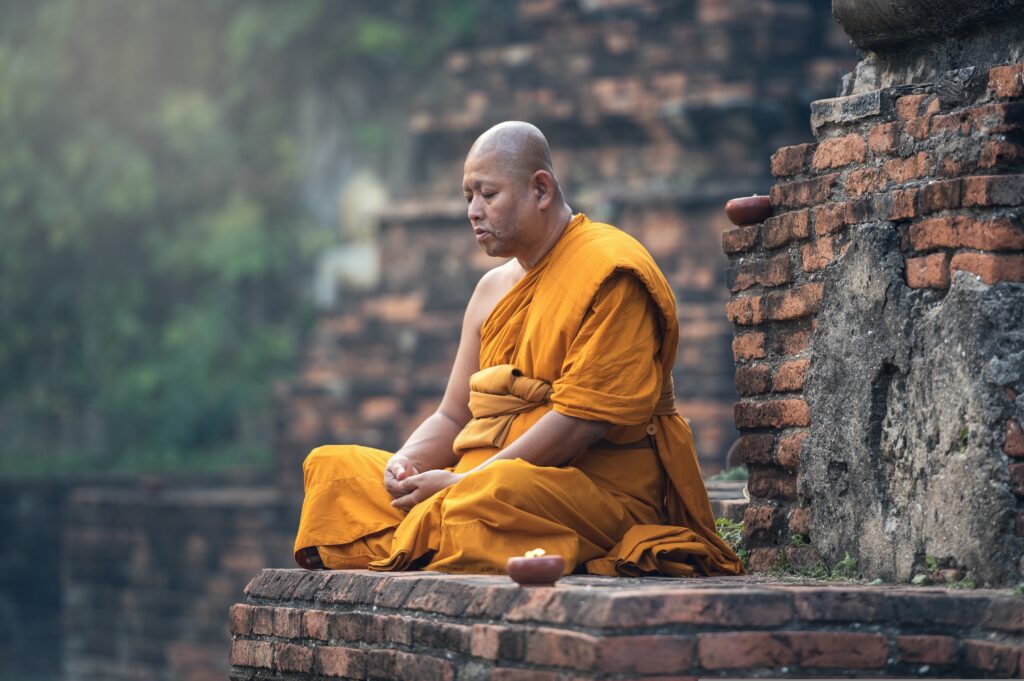
Over time, different regions and schools of Buddhism developed their own specific colors based on the materials available to them. Theravada Buddhists in southeast Asia used dyes from the plentiful Jackfruit trees in their environment to create their iconic orange robes. Vajrayana Buddhists in the Himalayas donned red and maroon robes due to their affordability in the high region. Mahayana Buddhists in Japan began wearing grey, black and dark blue robes to symbolize humility in a culture dominated by bright colorful kimonos.
Despite the plethora of colors, they shared a common symbolism. They represented a renunciation of worldly desires, a commitment to a monastic life, and equality among members of the Buddhist community. At the end of the day, anyone donning robes were simply Monks.
These flowing robes aren’t much different from a modern sports jersey. Sure, modern jerseys are typically flashy, adorned with team logos and, to the dismay of a lot of fans, plastered with ads. But it does share the underlying meaning that we find in robes. They represent a renunciation not of worldly desires, but other fandoms. Wearing your team’s jersey is a way to show off your commitment to the team. Lastly, they signal to other fans the unity and equality that comes along with being a fan.
Just as a Monk in orange robes knows he’s surrounded by like-minded individuals during a service at a Theravada temple, a person donning a vibrant purple jersey and matching baseball cap knows he’s surrounded by fellow Colorado Rockies fans with just a simple glance around his local sports bar. Regardless of the color or team, donning the uniform puts you on equal footing with members of your particular sports sangha.
Root, Root Rooting for the Home Team Instead of Chanting Mantras
“OOOOOHHHHHH-MMMMMMM-y god i can’t believe he just missed that free throw!” What starts out sounding like a bunch of Buddhist monks chanting in unison turns out to be the frustrated exclamation of thousands of NBA fans in a packed arena. Collectively ruminating over the boneheaded decision to sign that center that can dominate in the paint, but can’t hit a free throw to save his life(here’s looking at you Mitchell Robinson).
Buddhist monks chant for a variety of reasons. Buddhism was originally passed down orally. The Buddha’s teachings weren’t preserved in writing until almost 400 years after his death. Chanting mantras was a method to memorize and preserve his teachings. Some sects use chanting as a “sound object”. Much like the more well known method of focusing on the breath, chanting can be used as a tool to anchor awareness and enter a deeper level of concentration.
More importantly, chanting has long been leveraged as a tool to deepen community and connection. It is an instrument that can be used to literally voice the intentions of the monastery and sangha. It’s a physical manifestation of Anatta, or “non-self”. It is a way to vocalize the interdependence of all members of the sangha. When a group of monks or lay-people chant together, the unity of their voices is an expression of their unity as living beings.
We see this same concept come to life in major sporting stadiums. A crowd of fans chanting their favorite slogans, exploding in celebration, or booing the opposing team are united in their very being. For a brief moment of time the self slips away. Many become one. Effervescence takes over and washes away the ego. For a fleeting moment you forget you are a mother, accountant, American or whatever label you apply to yourself. You’re nothing more that a sports fan. Blending in seamlessly with the other sports fans around you. What was once a group of thousands of individuals is now an interdependent hive mind with a shared goal: to see the home team claim victory over their opponents.
There’s an “i” in Interdependence but There’s No “i” in Team
Buddhist wisdom can be found both on and off the field. Much like how we see fans become a unified organism off the field, we see interdependence in action on the court, field and rink. Joe Thorton was famous for dishing out no-look passes. His famous “the pass” from way back in 2007 will be forever remember in the annals of hockey history. Even the most efficient Zamboni can’t wipe away the memory of this iconic play.
Aside from being a historic moment, it is also a microcosm of the larger sangha and interdependence we see in fandom. The connection we see among fans outside the competitive playing field originates within the team itself. The players eat together, practice together, and sometimes even sleep in the same room as each other on road trips. It creates a bond that helps them function as one. “Jumbo Joe” Thorton didn’t need more than a fleeting glance to know Patrick Marleau was posted up outside the crease, perfectly positioned to bury the puck in the net. Non-self and interdependence display themselves on the rink and the field not in enlightenment, but in the form of jaw-dropping, highlight reel worthy plays.
Picking Your Team: A Lifelong Commitment to Your Sangha
Many of you reading this article probably already follow at least one major league sports team. Those of you that don’t are probably asking yourself, where do I start? It’s a daunting task. There are over 124 major sport teams in North America. The best way to get your feet wet is to start following your local teams. You could pick a team based on their color scheme, history or current line up. But to really maximize the sangha building aspect of professional sports you should start by following the teams nearest you. Proximity to the team and stadium will allow you the best opportunity to meet other fans, attend live games, and watch local broadcasts without having to deal with the confusing TV landscape that involves multiple streaming services and national/local broadcasts and blackouts.
You might not live near a “Big 4” franchise. And that’s OK! You can find the same sense of community by following minor league, college and even local high school teams. Start by putting yourself out there. Get out to games. Invite friends, family members, neighbors, co-workers and acquaintances. We’ve been looking at professional sports through the lens of building a sangha, and the best way to do that is to initiate community yourself.
Lastly, you have to understand that aside from interdependence, non-self, and sangha, your choice of team could teach you about another core Buddhist concept: Suffering! There are many franchises that have gone decades without winning a championship, some that have never won at all! At the end of the day, professional sports doesn’t have to be about winning. It can be an exercise in mindfulness. It can teach you to enjoy the rush of watching your favorite slugger hit a grand slam only to lose the game by 9 runs in later innings. To enjoy an ice cold drink on a warm fall day as your Quarterback gets sacked time and time again. Or simply enjoy the company of your newly formed sangha as your favorite hockey player gets crushed into the boards as he’s winding up for a game winning empty netter.