
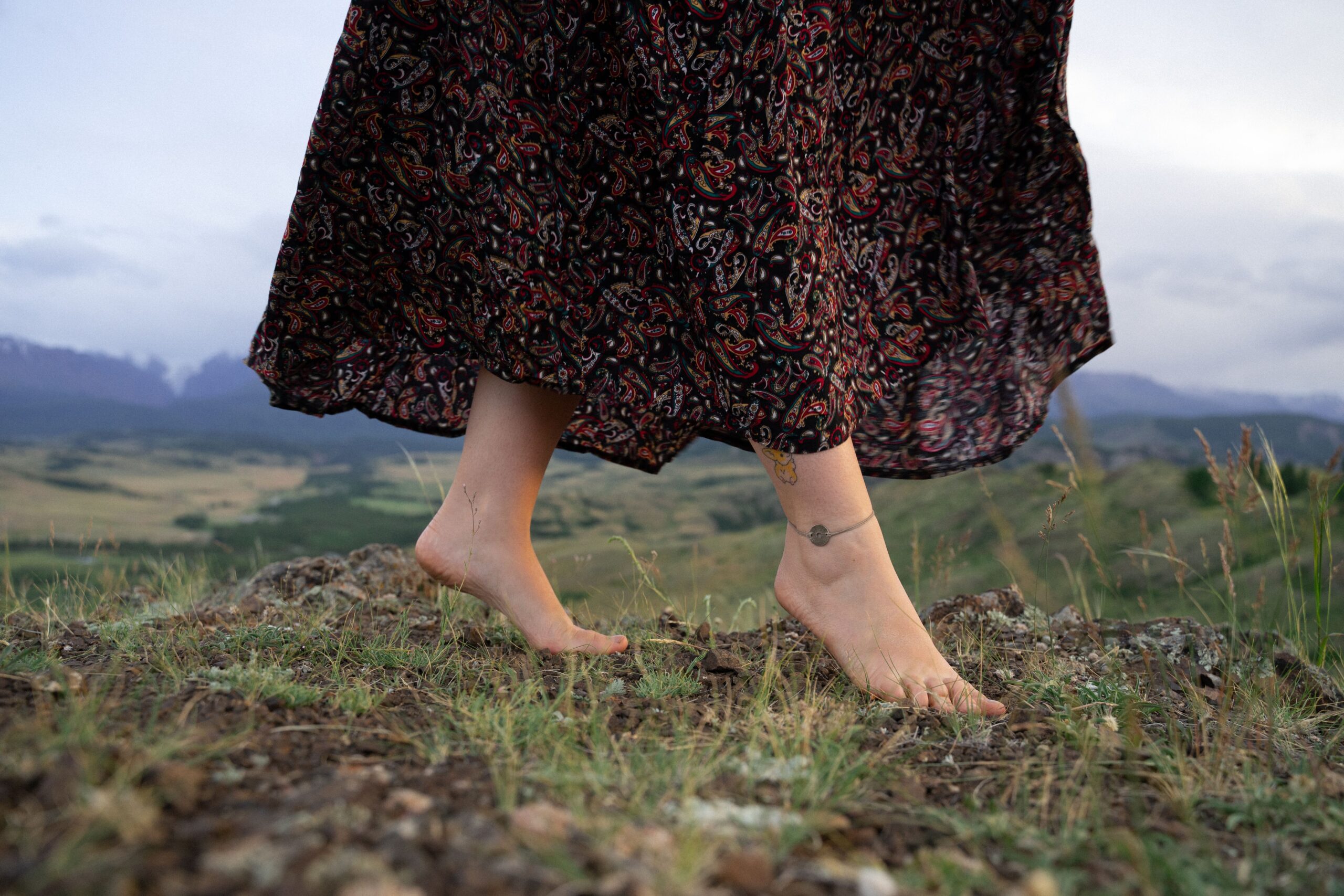
Combining new age wellness practices with ancient Buddhist meditation methods is a lot like introducing your extended family to your spouse’s extended family at your wedding reception.They don’t always jive. But just like your right-wing uncle Barry and your spouse’s far-left aunt Liz can find common ground in cursing the government for poisoning our children with chemtrails, the two philosophies can sometimes complement one another. Such as in the case of Grounding or “Earthing” and walking meditation.
What is Grounding?
Grounding, sometimes also known simply as “Earthing”, is the practice of making direct skin contact with the surface of the earth. Typically with your feet. Proponents of the practice believe that the earth carries a natural negative charge that can be absorbed through skin to earth contact. Supporters of the practice believe the body absorbs free electrons, which leads to an alleged wide range of health benefits such as reduced inflammation, improved sleep, and balanced stress. There are a small number of studies that show a correlation between grounding and the purported health benefits, but there is no definitive proof of those benefits at this time.
Is Grounding a Buddhist Practice?
No. At least not in the sense of kicking off your shoes and walking barefoot through a field of freshly mown grass at dusk as the fireflies light up the world around you, as relaxing as that might be. There is a concept called “grounding” in the field of psychology, which is a practice designed to focus you on the present moment and could be somewhat easily linked to the Buddhist practice of Mindfulness. But “grounding” or “earthing”, as in walking around barefoot, is not a Buddhist practice.
Grounding, the new age wellness practice, became popular in the late 1990’s and early 2000’s. When Clint Ober monetized the practice by creating a DIY conductive sleeping mat and later releasing a book, which he audaciously named Earthing: The Most Important Health Discovery Ever! Since then, Ober has released an entire line of grounding products that supposedly deliver the same benefits as the process of physically connecting with the earth. Grounding without… the ground.
Sure, people have been walking around barefoot for millennia, but the act of commercializing the practice, packaging it, and selling it online for $150 a pillowcase has only been around for about a quarter of a century. You won’t find stories of the Buddha speaking directly about earthing thousands of years ago, and you’re more likely to hear about it scrolling through social media than reading ancient sutras.
What is Walking Meditation
Walking Meditation, on the other hand, is over 2,500 years old. And there are an endless number of studies proving the health benefits of a regular walking meditation practice. Walking meditation has been proven to improve cardiovascular health as well as mental health. Regular walking meditation reduces anxiety, lowers HbA1c levels in patients with type 2 diabetes, and leads to a measurable reduction in cortisol levels.
It’s first mentioned by the Buddha himself in the Pali Canon. When the Buddha encouraged monks to be mindful in all four postures: walking, sitting, standing and lying down. The Satipaṭṭhāna Sutta, a discourse on the foundations of Mindfulness, notably stated “When walking, he knows, ‘I am walking.”, in reference to awareness while in a posture different from traditional sitting practice. The Buddha is believed to have introduced walking meditation as a way to balance long hours of sitting meditation. It allowed Monks to stretch their aching legs, cultivate mindfulness while in motion, and help integrate meditation into daily life. Essentially, it was a way for monks to squeeze more meditation and periods of mindfulness into parts of their days when they couldn’t sit idly.
How to Perform Walking Meditation
There are many different forms of walking meditation. Headspace has a great non-secular walking meditation for beginners. The framework below from Headspace, one of the best meditation apps available today, below provides a good starting point and outline to follow when beginning the practice. Follow each step for at least 30-60 seconds. Or feel free to hold your awareness on each step for longer if it feels natural.
- Body check – As you start to walk, notice how the body feels. Heavy or light, stiff or relaxed? Take a few seconds to become aware of your posture and the way you’re carrying yourself.
- Observe – Without trying to change the way you’re walking, simply observe your gait. Bring your attention to it. This can sometimes make you feel self-conscious, but that feeling usually passes.
- Tune in – Tune into what’s going on around you — passing cars, other people, window displays, trees, the movement and still of things, or any other sights that come into your awareness field. You’re not thinking about any of these things, though; you’re simply acknowledging what you see.
- Noting sounds – Notice the sounds that drift in. What can you hear? Again, try to realize any noise but not dwell on it.
- Familiar smells – Now turn your attention to any smells, whether pleasant or unpleasant. Notice how the mind habitually wants to create a story out of each smell and how it might remind you of somewhere, something, or someone.
- Physical sensations – Next, make a point of noticing any physical sensations, from how the weather makes you feel to how it feels as the sole of your feet touch the ground. There’s still no need to think about any of these observations. Simply notice, acknowledge, and let go.
- Movement – After a minute or two, contemplate the sensation of movement in the body: how the arms hang or swing by your side or how the weight steadily shifts from right to left. Observe your stride, your pace, and the rhythm you’ve become accustomed to.
- Focus on your rhythm – Use that rhythm — the soles of the feet touching the ground — as your base of awareness, a place you can mentally come back to when the mind wanders off. Repeat this throughout your walk, step by step, block by block, or mile by mile.
Incorporating Grounding Into Your Walking Meditation
If you look up an image of the Buddha, you’ll probably notice he’s barefoot. The Buddha and his early disciples often walked barefoot. But not with the intent of skimming electrons from the surface of the earth. They did it to show humility, embrace simplicity, renounce attachment and desire, and more plainly, they didn’t own any shoes. The Buddha and his followers lived off of alms from the community, and it wasn’t common for shoes to be donated by lay people. Monks were permitted to wear simple sandals to protect their feet on rough terrain, as a way to honor the philosophy of the “Middle Way“, a core Buddhist tenant that urged practitioners to find a compromise between extreme hardship and comfort. But they generally went shoeless.
As a result, most Buddhist monks and the Buddha himself practiced walking meditation without shoes. While it wasn’t intentional, it led to a number of benefits that made the experience more mindful. As you can see in the walkthrough above, noting sensations and being mindful of the body are a key aspect of walking meditation, which is a lot easier to do when your feet are unencumbered and open to the elements.
Performing walking meditation barefoot, or while “grounding”, allows you to note additional sensations during the body check. Are your feet hot? Cold? Is there harsh bumpy pavement under your feet? Cool grass? Or squishy sand? While checking in with physical sensations you again have an expanded opportunity to experience more than you could with shoes on. Feet have more nerve endings than most other parts of the body. The soles alone contain over 200,000 nerve endings per foot. Making them a great receptor to physical touch. Finally, when focusing on the rhythm the more intense feeling of foot hitting earth or pavement will make maintaining focus easier than when the sensations are muffled by a shoe.
Instead of being limited to the feeling of your feet being crammed into sweaty socks, you can now appreciate one of the five skandhas, or aggregates. In Buddhism, the five skandhas are the five physical and mental components that make up the human experience. The first one being form or “Rupa”. Rupa is the physical body and the material world. It also includes the five traditional sense organs you use to observe that world: eyes, ears, nose, tongue, and body. Its external objects, as well as the physical body you used to observe those external objects.
By ditching your shoes and following in the (bare)foot steps of the Buddha and his followers, you’re actually enhancing your walking meditation. You’re more in touch, both literally and figuratively, with your senses and are forming a more intimate relationship with one of the five skandhas, Rupa. So the next time you’re practicing walking meditation, try kicking off those shoes. But it’s probably best to practice at home and not on your walk to work.