The red pill or the blue pill? Enlightenment or the endless cycle of samsara? One is a trope invented by “The Matrix“, a 1999 science fiction film starring Keanu Reeves and Laurence Fishburne. The latter is an ancient Buddhist doctrine that states all beings are constantly experiencing an ongoing cycle of life, death, and rebirth. They couldn’t be any further apart in theory or conception. Or could they?
One could argue the non-duality of the two concepts. Even going as far as saying that they’re one in the same. The “Red vs. Blue pill” ideology being championed by the matrix’s “Morpheus”, played by Laurence Fishburne. And the concepts of enlightenment and Samara represented by bodhisattvas, enlightened beings in Buddhism who have delayed their own enlightenment to help all other sentient beings achieve enlightenment.
You could even go as far as arguing that Morpheus is a Bodhisattva. Possibly even humanities’ last Bodhisattva. One who has sacrificed his own satisfaction and comforting delusions to pull others who are trapped in the Matrix out of their digital slumber. With the end goal of battling the machines powering the simulation that is keeping all of humanity suspended in an artificial reality and to awaken all humans and free them of delusion.
What is a Bodhisattva?
Before we can understand how Morpheus is a bodhisattva. We must first understand what a bodhisattva is. The concept of a bodhisattva is prevalent is all sects of Buddhism, but is central specifically to Mahayana Buddhism. In fact, it’s one of the most defining beliefs of Mahayana Buddhism. The ultimate goal of Theravada Buddhism is Arhatship. Which is an individual’s attainment of enlightenment and the individuals escape from suffering. Conversely, Mahayana Buddhist believe the ultimate goal of Buddhist practice is to follow the Bodhisattva path. The Bodhisattva path teaches that one should not strive for enlightenment just for themselves, but for all beings.
Mahayana Buddhists believe Arhatship is an incomplete form of awakening. Claiming that its not possible for an individual to achieve enlightenment unless all beings become enlightened. In Mahayana Buddhism, a Bodhisattva delays their own escape from the cycle of samsara to help others break free from the cycle. In fact, to become a Mahayana Buddhist, one must make three vows.
The first being taking refuge in the “Triple Gem” or The Buddha, The Sangha and The Dharma. The second being the promise to integrate core ethics into their everyday life: The Noble Eightfold path and the Five Precepts. The final, and most relevant to this exploration, The Bodhisattva Vow. Which isn’t just an awesome hip-hop song by Adam Yauch of the Beastie Boys, but also the commitment to achieve enlightenment not just for oneself, but for the liberation of all sentient beings from suffering. Making sure to prioritize others’ well-being above one’s own.
What makes Morpheus a Bodhisattva?
The Matrix is rife with examples and allegories of Buddhist beliefs. Such as the difference between relative and absolute truths. One of the most apparent to experienced practitioners is Morpheus’ role as a Bodhisattva. Throughout the film Morpheus plays the role of mentor, protector and Shepard. Putting himself in great danger to liberate all sentient beings within the Matrix.
Morpheus Embodies the Spirit of the Bodhisattva by Following The Wisdom of the Lotus Sutra
We’re first introduced to Morpheus when he reaches out to the main protagonist, Neo. Morpheus begins dropping breadcrumbs for Neo to follow. He hacks Neo’s computer to display a message on his monitor, sends a mysterious package containing a cell phone, and finally meets him on a rainy bridge to begin the process of disconnecting him from the Matrix by removing a tracking bug from Neo’s body.
Morpheus’ role as a bodhisattva begins at the very first contact. He reaches out to Neo to encourage him to “Follow the white rabbit“, which ends up being a woman with a white rabbit tattoo. Morpheus’ tactic aligns with strategies seen in “Parable of the Burning House” from the Lotus Sutra. He doesn’t force Neo to seek enlightenment or coerce him with unskilled methods. Instead, he capitalizes on Neo’s natural curiosity and quest for truth.
In the Lotus Sutra, a families house is on fire. The children are inside playing with toys and refuse to leave because they are completely unconcerned with the danger. The father knows the children won’t leave for the sake of safety. So instead of reiterating the danger, he yells that he has even better, magical toys waiting for them outside. The children then run outside to get the toys and are saved. Once the children are safe, he gives them something even better than what he promised.
We see Morpheus utilize the same tactics. Rather than try to scare Neo or convince him he is living in delusion within the Matrix, he uses skillful means to prod Neo towards the truth. Prior to reaching out to Neo, Morpheus studies him for years. Compiling information and learning about him as an individual. He discovers that Neo has an intense desire to learn the truth and reveal it to others, as evidenced by his long paper trail of new articles covering his exploits as a skilled hacker responsible for leaking government files. In some ways making Neo a Bodhisattva himself!
Morpheus doesn’t coerce Neo into reaching the epiphany. Instead he uses skillful compassion. Knowing that Neo has a thirst for truth, Morpheus points him in the direction of a reality shaking ultimate truth. A truth bigger than anything he has ever exposed before; that the world he lives in is simply a simulation run by a master race of indifferent, soulless machines. Morpheus displays his deep understanding of compassion and Right Action. He knows a person like Neo wouldn’t want to walk through life with the wool pulled over his eyes. He also understand thats a person like Neo wouldn’t want to be spoon fed the truth. Instead of simply telling Neo the truth, he compassionately and skillfully gives Neo the tools he needs to discover it himself.

Morpheus Follows Precepts of the Bodhisattva Vow
In addition to following wisdom found in the Lotus Sutra, we also see him exemplify some key aspects of the Bodhisattva vow. Namely: Patience or “Kshanti“, Non-Violence or “Ahimsa“, and Respect for Agency.
Patience or “Kshanti”
Kshanti isn’t simply the act of waiting. Its true meaning goes deeper. It’s the ability to endure confusion, doubt, and resistance without anger or force. We see this in the way Morpheus prods Neo towards enlightenment from the machines and liberation from the Matrix. Morpheus doesn’t rush Neo through the process of breaking free from the Matrix, despite believing Neo may be the only person that can liberate the entire human race. Morpheus waits years to find “The One,” following prophecies without certainty that they will ever come true. He never gets angry or disappointed at the previous people he thought could possibly have been “The One” yet failed to fulfill the prophecy. Such as Cypher, the man most often remembered for the scene where he is eating steak while pondering the meaning of “reality”.
Morpheus remains calm and compassionate with Neo through his many failures. When Neo tells Morpheus “I don’t believe in fate”, Morpheus never argues or pressures him to align with his own beliefs. He instead remains patient and allows Neo to follow his own path. Neo fails during his training, such as in the jump program or sparring with Agent Smith. Morpheus doesn’t react with frustration or cause Neo any humiliation. Instead remaining calm even when his own beliefs about Neo being “The One” are challenged. Morpheus even suffers on behalf of Neo in order to avoid rushing him through the process, such as when Agent Smith tortures and kidnaps him in an attempt to lure Neo into a trap.
Despite all the challenges, Morpheus faces all the confusing and challenging portions of Neo’s path to enlightenment with grace and compassion, even when they cause him to be doubtful of his own beliefs. Because he understands Neo can’t be told the truth, he must discover it himself. Morpheus famously tells Neo:
“I can only show you the door. You’re the one that has to walk through it.”
That line is Kshanti pāramitā doing a slow-motion walk in a trench coat and sunglasses.
Non-Violence or “Ahimsa”
Ahimsa isn’t strictly pacifism in all situations. It’s true meaning is to minimize harm and avoid unnecessary violence. It is the refusal to increase or expand suffering. Especially toward beings trapped in ignorance or Samsara. We see this in many of Morpheus’ actions throughout the film. Early in his training Morpheus makes it clear to Neo that, aside from the agents, other beings in the Matrix aren’t enemies, they’re also victims of the Machines. He explains to Neo that killing someone in the Matrix kills their physical body in the real world as well. This underscores karmic consequence. The violence that occurs within the Matrix isn’t neutral. It has real, observable cause and effect. Killing someone in the Matrix being the cause, and their death in the real world being the effect.
Morpheus channels his inner Bodhisattva and embodies Ahimsa in another famous quote when referring to other’s in the Matrix that haven’t been “woken up”:
“You have to understand, most of these people are not ready to be unplugged.”
This short sentence put’s Morpheus’ compassion and pacifism on full display. Morpheus understands that most people inside the Matrix are psychologically dependent on it. That pulling them from the Matrix will have catastrophic effects on them. Forcing awakening on them would shatter their identity and cause immense suffering because they mentally aren’t ready to accept the truth. Awakening them before they’re ready is akin to an act of violence. Which is why he carefully selects his candidates that he believes to be “The One,” even studying them for years before contacting them as he did with Neo.
You might be wondering, isn’t violence against the Agents in conflict with Ahimsa? The answer is no, because of the essence of the agents. Morpheus teaches Neo that humans plugged into the Matrix are sentient beings worthy of protection. Yet he makes a very important distinction between the humans and agents, pointing out that the agents non-sentient system processes. Incapable of awakening and not true sentient individuals at all.
They are simply extensions of the greater network, or hive-mind, that is the machine race as a whole. Defeating an agent doesn’t cause them direct harm because they are simply extensions of a greater system. Much like removing a claw from a crab that will grow back because they creature as a whole is still living and breathing. Because the agents are not capable of dying or suffering, causing harm to them in the form of physical violence doesn’t actually cause suffering.
Respect for Agency
This is the most obvious Bodhisattva aspect of Morpheus as a whole. Mahayana Buddhism teaches that no one can force enlightenment. Compassion without consent is a form of domination. A Bodhisattva cannot make someone become enlightened unless they are willing to put in the work themselves. In traditional Buddhism this takes on the form of Koan work, meditation practice and taking refuge in the three jewels. In the Matrix this is Neo’s strenuous training program and his right to choose enlightenment for himself or return to the simulation.
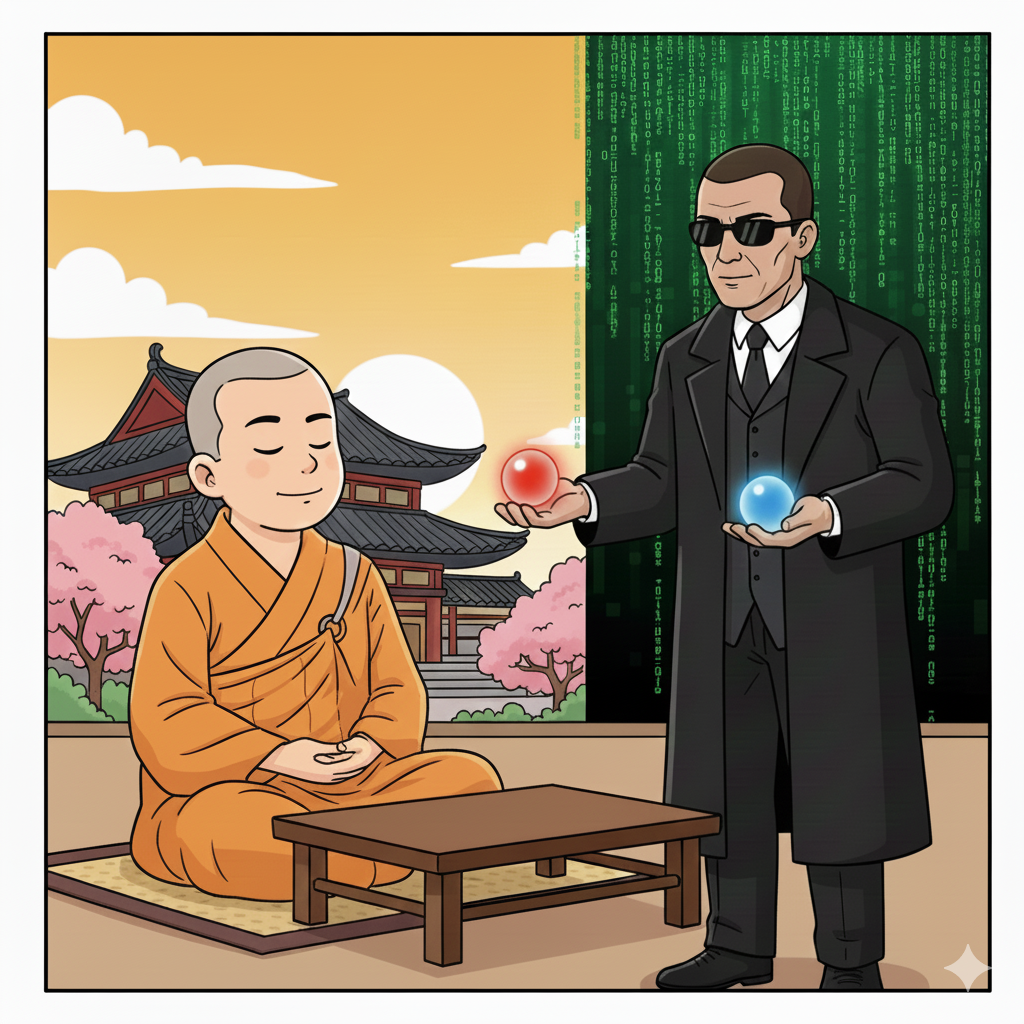
This is where the Red and Blue pill enter the picture. In the film, Morpheus offers Neo the choice between the Red pill and the Blue pill. The Red pill, which dispels the illusion of all those trapped in the matrix and reveals the truth that they’re living in a simulation. And the Blue pill, which allows you to continue living in the ignorant bliss. The Red pill representing enlightenment, the Blue pill representing the endless cycle of samsara.
Throughout the film Morpheus never forces awakening on Neo. Despite his overwhelming belief that Neo is “The One”, Morpheus allows Neo to carve his own path. As we stated earlier in this article, a Bodhisattva is defined by their choice to delay their own enlightenment in order to shepherd others towards enlightenment.
Technically, Morpheus is already enlightened. He knows that the Matrix is merely a simulation. So he really isn’t delaying his own enlightenment. But, in some ways, he is. He makes the decision to regularly reenter the matrix in order to free others that he believes could be “The One”. So, in a way, he is delaying his own escape from Samsara by reentering the simulation. He is choosing to reenter the film’s version of Samsara. Instead of staying in the real word, he exposes himself to danger to give others the choice on whether or not they want to wake up from the simulation.
His actions have bodhisattva nature. He has made it his goal in life to free as many people as he can from the simulation. Yet he does it in a roundabout way. He doesn’t simply free as many people as he can. He uses Right Understanding, from the Noble Eightfold path, to see that finding and freeing “The One” will lead to all humans being freed from delusion. Morpheus is calculated, compassionate and intentional in his actions. Which, if he succeeds, will lead to the freeing of all people. His goal to break all humans free from the simulation parallels the end goal of Bodhisattvas trying to bring enlightenment to all beings. Making him one humanities last Bodhisattvas.
Morpheus can leave the Matrix at any time, but his vow-like commitment is revealed in the fact that he keeps going back, not because he must, but because others still suffer inside. Like a noble Bodhisattva, he will not rest until all are free.