
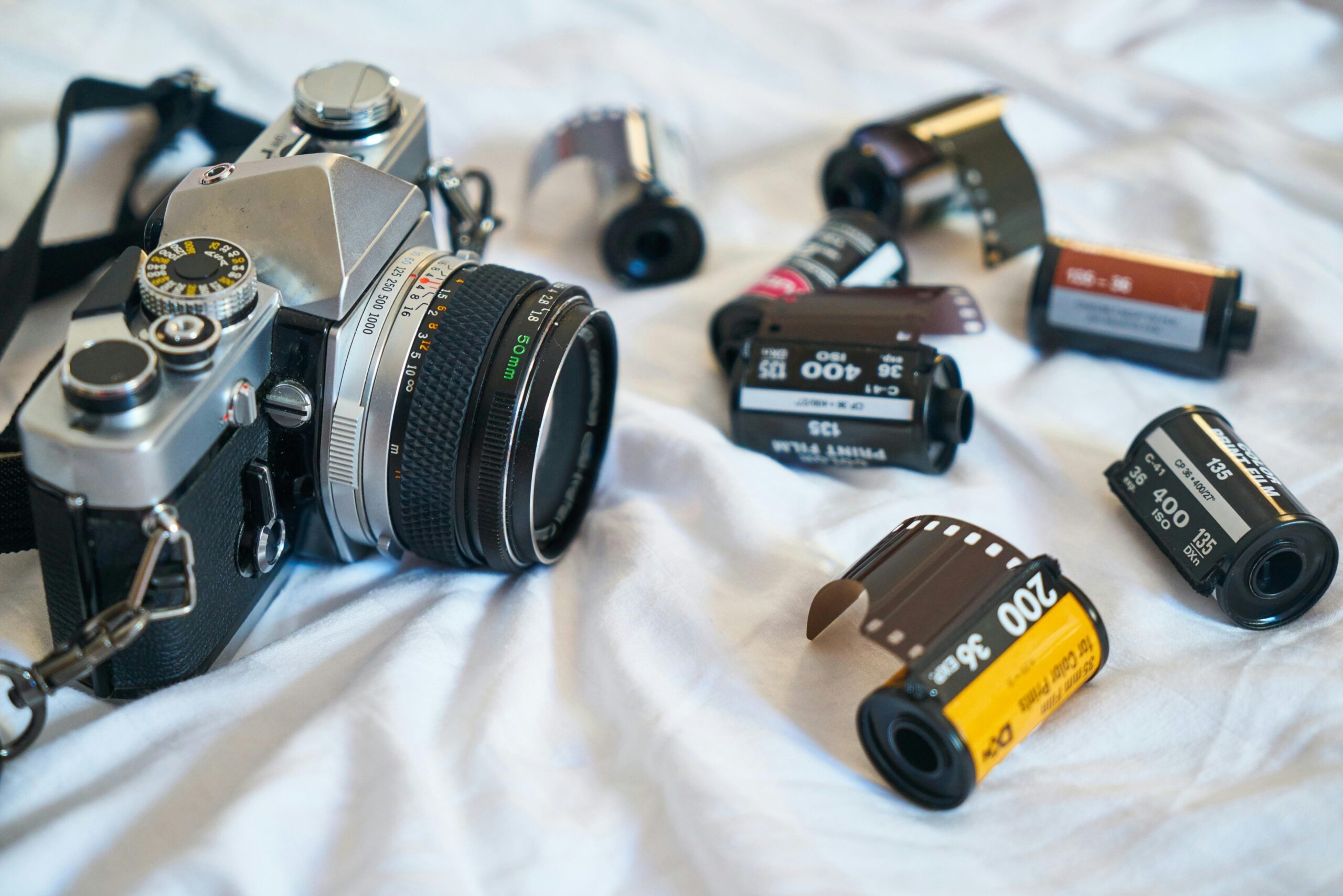
Pull out your cell phone and open up your photo gallery. Do you have ten to fifteen nearly identical versions of every picture on your digital camera roll? If the answer is yes, read on. We’ll teach you how to pare down that massive photo library while simultaneously living a more mindful life. How? A medium on the brink of extinction that can take you down the middle way, Film Photography!
Log onto any social media platform and you can’t help but be aware of the film photography resurgence sweeping the nation. YouTubers, Instagram influencers, even your old college roommate that you haven’t actually spoken to in at least ten years. It seems like everyone is posting those throwback photos with that classic film grain look that just can’t be replicated by digital cameras. The classic aesthetic is enough to get most people to buy a ticket to jump on the bandwagon.
But what if there was a deeper meaning and reward to using classic 35mm film? Below the surface of those glossy 5×8 prints delivered to your door is the path to enlightenment… or at least a more mindful life. Film Photography can be a vessel to a deeper understanding but, like a portrait with a little too much bokeh, it can be hard to see past the main subject. We’re taking a deeper look at how a seemingly simple hobby like film photography can actually provide a snapshot into understanding Buddhist concepts like wabi-sabi, patience, living in the moment and non-attachment.

Wabi-Sabi: The Joy of a Crooked Compostion
What is Wabi-Sabi?
People often misunderstand the concept of Wabi-Sabi. It has roots in Buddhist thinking. It is a cornerstone concept in both Zen Buddhism and Japanese culture as a whole. It’s been said to be difficult to define, and many Japanese people will tell you that it takes on a slightly different definition, depending on who is explaining it to you, as each individual has their own unique interpretation. Despite it’s slight variations, there is a generally agreed upon wider understanding. It was originally conceptualized as the act of finding the beauty of all “imperfections” nature. Overtime the definition was expanded to include non “natural” things; pottery, homes and structures, and even photos!
Wabi-Sabi is about seeing past the external appearance of something. To fully understand Wabi-Sabi you must look below the surface and see an objects hidden inner qualities. You Must see how the item embodies the Buddhist concepts of impermanence (mujō), suffering (dukkha) and emptiness or absence of self-nature (sunyata). It’s a high contrast to the Western view of beauty many of us grew up with. Where there is a high emphasis on perfection to the point of unachievable body images. While western beliefs cause us to strive for 28 inch biceps and 22 inch waists, the Japanese emphasis on Wabi-Sabi asks us to be more accepting of natural imperfections.
Wabi-Sabi is about pausing to appreciate the time it took for copper to develop a beautiful patina. The asymmetry of the wood grain in a wood floor and how the Samsara cycle of that particular tree used in that board created that pattern, or the impermanence of moss growing on a stone in a Zen garden. The focus of Wabi-Sabi is in the atmospheric feeling an object exudes, not the external appearance. It’s about embracing external appearances that may be initially unfavorable, and finding the beauty within.
How is Wabi-Sabi Related to Film Photography?
You can think of film photography as something of a Koan, where the true meaning isn’t readily apparent. Many families will painstakingly set up each shot. Waiting for the perfect lighting, ensuring all the subjects are looking at the camera with their best smiles, altering the angle to get that breathtaking background perfectly in frame. The end goal is the perfect photo. But is it really?
In today’s modern world of influencers and social media personalities it might be, but for many of us it’s about something much deeper. It’s about capturing a moment in time. Whether you’re a wedding photographer trying to snare the moment bride and groom look lovingly into each other’s eyes before saying “I Do”, or a mother trying to wrangle three kids into showing the exuberance of a trip to Walt Disney World on their faces as they pose in front of Cinderella’s Castle, the photo itself isn’t what’s important. It’s what the photo represents.
As a Buddhist you may be thinking “But all things are impermanent! How can holding attachment to a specific moment lead to a more mindful life?”. The answer is in the nature of the medium and embracing Wabi-Sabi. Film photography forces you to accept the present moment, with all of it’s imperfections. The image you capture may not be perfect in a lot of ways. Yet it perfectly represents the moment you clicked the shutter button. Unlike a modern cellphone or digital camera, you can’t take 10-20 shots in rapid fire and delete the rest. You get one chance. You capture one moment.
The composition of the shot might a little crooked, one of the subjects might be looking away or blinking, it might not be perfect. Embracing Wabi-Sabi allows you to accept the imperfect photo for what it is. What you see is what you get. No editing in post production, no 10-20 versions to choose from or blend together using newfangled AI photo editing technology that is being installed on all of our phones.
Film Photography and Wabi-Sabi work together to bring you a more mindful perspective. Instead of spending hours editing and deleting photos looking for the perfect one you simply snap the shutter and move on. You have more time to enjoy living in the moment. Instead of creating the perfect representation of the moment through carefully curated and staged images. Accepting that you won’t have the perfect photo also allows you to focus on the moment at hand, not creating a perfect photo of the moment at hand.
This change in perspective allows you to focus more on the current moment. You’ll still have memories of that specific trip or event you’ve captured on film. It will even be a more accurate representation of that specific trip or event. Years later you may end up laughing about how a member of your family was looking away in each photo, or the ice cream stain on your loved-one’s shirt that may have been edited out in digital copies. Film forces you to accept the reality of the present moment, imperfections and all.
Film Is a 24-Exposure Lesson in Patience
Patience is considered one of the key virtues necessary to live an ethical life and practice. It is part of the Six Paramitas, or Six Perfections as a part of the Tolerance Paramita. In short, the six Paramitas are states of mind that lead us to liberation from suffering and enlightenment. Much like the Noble Eightfold path they don’t exist in isolation, but are most effective when blended together. You could make the case that Film Photography can help an individual practice all six Paramitas, but Patience is the most obvious example.
Patience is the ability to endure difficulties without getting angry or upset. We see this not only in the act of waiting for our negatives to be developed, which can become a frustrating experience as your desire to see the snapshots of your latest trip or event grows, but also in the present moment of capturing each photo. Your subjects will not always be looking in the right direction or smiling at the right time. The lighting will not always be perfect. Passers-by may walk into your frame just as you press the shutter button.
That’s all ok! The finality of film photography teaches you to accept these imperfections and frustrating situations. Once the negative is exposed to light there’s no going back. You can’t simply take another shot without burning through another frame of film. Instead, you must learn to accept the photo for what it is. You must learn to be patient with your subjects. The patience Paramita is the willingness to rest with ease with anything that is, even your imperfect photographs. Rather than being angry with your subjects of the situation you can simply accept them. Sit with the imperfections, embrace the imperfections, be patient with the imperfections.
Zen and the Art of Letting Go of Overexposed Negatives(And All Of Your Money)
Developing printed copies of your photos and the concept of non-attachment might seem contradictory at first but, like Wabi-Sabi, you must go through the surface layer to see the real beauty. Anyone that has ever used a film camera before knows that not all shots will turn out well. Overexposure, underexposure, light leaks, multiple exposures, frame overlapping, the number of issues you can experience knows no bounds. Switching from digital to film photography forces you to learn to let go.
That snapshot you took might not turn out. And that’s OK! Sure, you form attachment in the sense of having physical copies of your photos, but you also learn to let go of certain moments. You learn to place less emphasis on particular photos or moments. Knowing that each photo you take may not see the light of day, or maybe too much of the light of day in the sense of overexposure, causes you to let go of attachment. You learn that even if one particular photo doesn’t turn out you have twenty three, or thirty one, other exposures on that roll of film to fall back on and enjoy.
Lastly, as many film photographers already know, buying and developing film is expensive! Buying a film camera can set you back anywhere from $50 to hundreds or even thousands of dollars. Then there’s the cost of film which can run anywhere from $5 to $20 per roll. Throw another $10-$30 in to have each roll developed and suddenly you find yourself living as a monastic, not because you’ve dedicated yourself so deeply to the practice, but because you’ve missed your mortgage or rent payment because so much of your budget is going to your newfound hobby! This last point is a bit tongue in cheek but the expense of making the switch is important to note for anyone entering the hobby.