
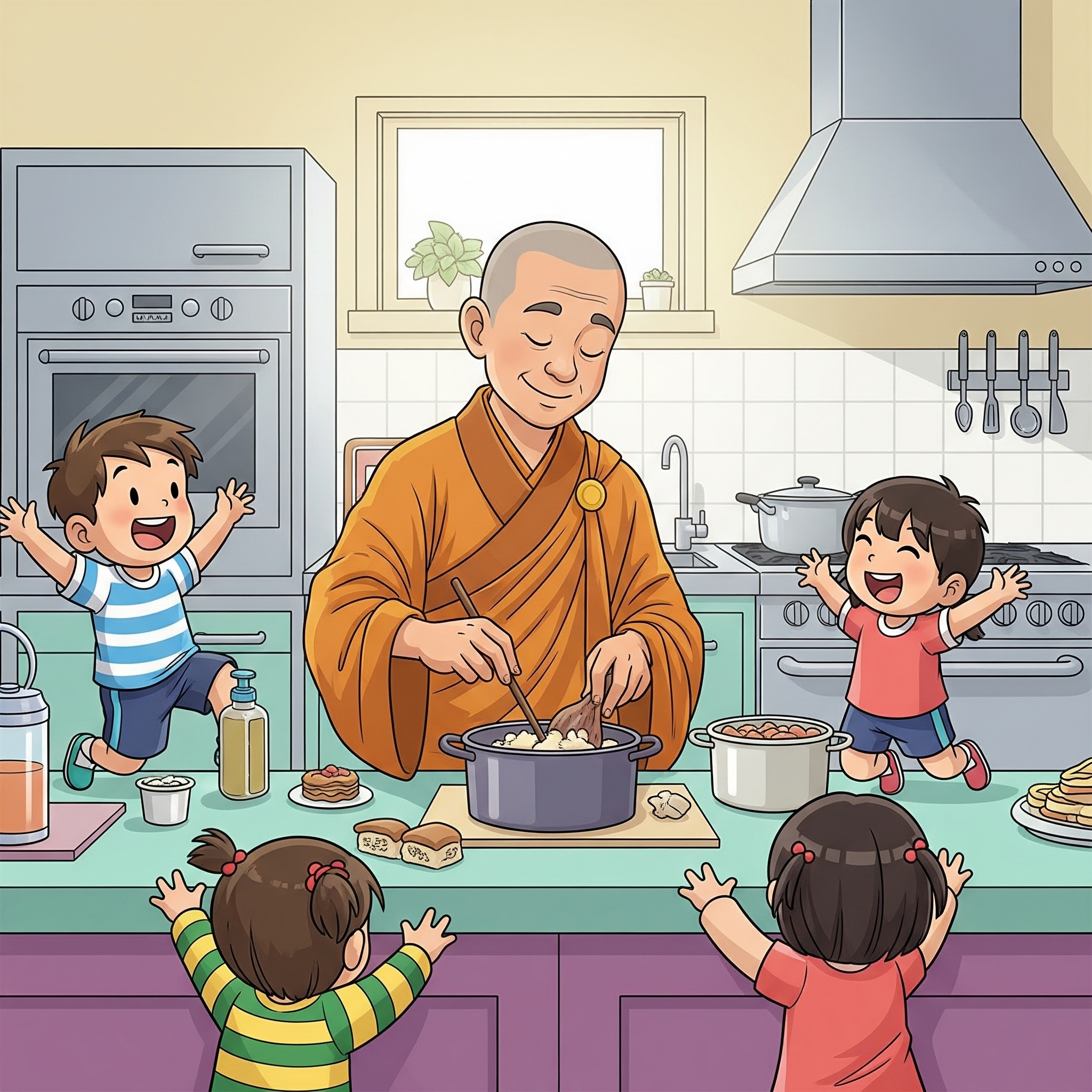
Parents today are more stressed, overworked and pushed to their limits than ever before. Feeling like finding time for a traditional sitting meditation practice is out of reach? You’re not alone. In today’s modern world there simply isn’t enough time in the day to sit in silence for busy parents. As we move further from the traditional family dynamics of the past we have to learn to meditate in non-traditional ways. Thankfully, with inconceivable foresight, Dōgen Zenji, provided us with a framework to move closer to enlightenment one meal at a time. “Instructions to the Tenzo” provides us with the tools and knowledge we need to incorporate Zen practice into our daily dinnertime routine, a task many people don’t recognize as the meditative pursuit that it is. Dogen teaches us to turn ordinary work into deep practice, by sprinkling a little Zen into each dish like garlic and onion.
Who was Dogen Zenji?
Zen master Dōgen lived from 1200–1253 AD. He is the founder of the Mahayana Sōtō sect, one of the five major denominations of Japanese Buddhism. Dōgen studied under the tutelage of his mentor Rujing during a four-year visit to China from 1223 to 1227 AD. He is said to have achieved enlightenment during this time and transmitted those teachings to Japan after returning to a remote part of Kyoto. He was a Zen master, philosopher and poet. Despite his long resume of impressive feats he is most known for his Shōbōgenzō, a collection of works written in the 13th century.
Despite his works being written over 700 years ago they’re still relevant today. One of his most known works is “Instructions To the Tenzo”. It is a framework for Buddhist monks who took on the responsibility of providing daily meals for the rest of the Sangha. While many of the people reading this may not be feeding dozens of monks, preparing food for your family can feel like it at times. The wisdom found in “Instructions to the Tenzo” can be applied to modern families gathering around the dinner table and the stressed out parents making those meals possible.
Instructions to the Tenzo: A Brief History
Dōgen wrote instructions to the Tenzo, also sometimes known as Tenzo Kyokun, as a guide for Zen monks. More specifically for the cook at a Zen monastery. It was a way to acknowledge their important role in the community while also creating the opportunity to practice, despite their busy schedules. He saw the role of the Tenzo as a vital part of the Sangha. He saw their daily tasks a way to embody the principles of Zen in everyday life.
It is said the seeds for this work were planted when studying at the Tiantong Monastery. He witnessed an elderly monk airing mushrooms for the evening meal in the hot sun. He asked the monk why he didn’t employ the help of younger monks or wait for comfortable conditions, to which he replied:
What time should I wait for?” I took my leave, but as I walked along the corridor, I began to realize how important an opportunity this position affords.
Several months later Dogen encountered another Tenzo while on a ship in Qingyuan. This elderly monk was looking to purchase Japanese Mushrooms. He asked the Monk about his tasks and work and wondered why, an elderly monk with limited mobility, would travel so far to acquire the ingredients. Again he asked why the monk did not delegate the task to a younger monk. The old monk explained to Dogen that Zen is all encompassing. Your practice is not limited to sitting.
He told Dogen that when cooking you’re not just cooking for the people around you. You’re also cooking for the Three Jewels: The Buddha, The Dharma and the Sangha. The old monk explained that even the most mundane or monotonous tasks can bring you closer to enlightenment. Dogen internalized the old monk’s lesson and later wrote out specific instructions for Tenzos, so that they could practice the old monk’s wisdom.
In general, the job of cook is an all-consuming pursuit of the way. If one lacks the way-seeking mind, it will be nothing but a vain struggle and hardship, without benefit in the end.
-Elderly Monk
The Three Minds of Dinner Time
You might be thinking, I’m no Tenzo, how can these lessons be relevant to me? Well, being a parent at dinnertime can feel like cooking for an entire Sangha of people. While your family may only be three to six people the task of cooking can feel as immense as cooking for a group of over one hundred hungry monks. Applying the lessons from “Instructions to the Tenzo” can help you feel a sense of Zen while cooking. The special ingredient to transform this task into a mindful activity? Sprinkling Dogen’s “three minds” from “instructions to the Tenzo” into your daily cooking ritual like grated parmesan on a plate of Parmigiano Reggiano.
What are the Three Minds?
Joyful Mind (Kishin)
Joyful mind, also known as Kishin mind, simply means approaching the work with joy and gratitude for the opportunity to serve. Cooking and serving your family day after day can begin to feel tedious and like an inescapable chore. Boiling pasta, sautéing chicken, and roasting veggies can make you feel like Sisyphus pushing a boulder, or maybe in this case a giant meatball, up a mountain day after day, forced to return to the bottom after reaching the summit the night before. It’s important to incorporate right view and Kishin mind into the task to keep your spirits lifted and bellies full.
While you may feel trapped or burned out it’s important to remember there are many people out there that would give anything to be in your position: people without money to feed their family a nourishing meal, couples struggling with infertility that would give anything for a family to feed, or even individuals that have lost family members to tragedy and would give anything to sit down to one more meal with the person they lost. But what is Joyful, or Kishin mind, and how can it help you practice gratitude?
Thomas Wright translated Dogen’s description of Kishin from “Instructions to the Tenzo” as:
“A joyful mind is a positive attitude. It means being grateful for our lot and not complaining. Even though we may suffer hardships, we should be thankful that we have sufficient food and clothing to sustain our lives and practice.“
To boil these words down, like a delicious consommé sauce, this means to simply be grateful for your current situation. Your health is well enough that you can stand in front of a hot oven, your arms strong enough to lift and chop the ingredients and your senses sharp enough to enjoy the rich smell wafting up from your cook top. You have a family, that may drive you crazy at times, to support and which supports you. And lastly, you have the financial means to provide for these people. While you may not be eating filet mignon every night you are eating. You and your little ones are not going to bed with empty stomachs.
In short, Kishin mind is appreciating the opportunity to serve and break bread with your family. You may be faced with difficulties such as finding the time to cook in your busy schedule, complaints from picky young palates that would prefer mac and cheese or chicken nuggets over whatever is on the menu that night or budget restraints that force you to serve spaghetti over lobster or some other luxury food item. But you are still eating.
While all these challenges may seem overwhelming in the moment, it’s important to contextualize them. Keep in mind that there are many people that would give anything to be in your place, remind yourself that your picky toddlers will one day rather grab fast food with their friends after school instead of eating at home, and be grateful for the opportunity to extend loving kindness to them in the form of a tasty casserole. Dogen ecourages us to appreciate whatever situation we, or the Tenzo, are in. With a focus on cultivating joy in the opportunity to be there.
Parental Mind (Rōshin)
When it comes to relating Dogen’s “Instructions to the Tenzo”, you can’t get more on the nose than Rōshin. It’s also referred to as “Old Mind,” “Parental Mind,” or “Nurturing Mind”. Regardless of what you name it, the premise remains the same. Rōshin is a deeply empathetic, selfless mindset. Dogen spoke directly about parents when explaining Rōshin, stating:
An old mind is the spirit of a parent. It is the mind of a parent who cares for his or her children. A parent raises children with great care, never thinking of the hardships as burdens. Out of love, a parent will willingly undergo any difficulty, always wishing the best for the child. Practicing in this way, you should maintain the mind of a parent.
When cooking for your family, it’s not overly challenging to maintain Rōshin mind for the people you’re directly cooking for. Yet, it can become an even more powerful tool, or mindset, when you extend that same loving-kindness to the ingredients you’re using to nurture those people. It means approaching the task of cooking with the same devotion, kindness and love that you feel for your family. This means every single ingredient down to the smallest grain of rice.
Dogen said that your mindset should be so focused when cleaning rice for consumption that not a single grain is thrown out with the sand. He said that each ingredient should be handled “as carefully as if they were your own eyes”. There is a meticulous detail that should go into every step of the process. When properly applied, Rōshin mind can cultivate a sense of Samu because applying this level of focus to your daily task forces the mind into a state of constant mindfulness.
Taken at face value, Rōshin mind ensures care and mindfulness, but when you look deeper into the meaning of Rōshin mind you find that this meticulous detail is a metaphor for the blending of practice and perception. Cleaning sand from your rice is a Koan in disguise. A conversation between Xuefeng Yicun, another a highly influential Chinese Chan-master, expands upon this premise:
Dogen asked Xuefeng: “Do you wash the sand away from the rice, or the rice away from the sand?“, Xuefeng replied, “I wash them both away together.” Dogen then asked, ‘What will the community have left to eat after this process?‘
The Koan highlights the danger of discarding the good with the bad. It challenges our conceptualization of what good and bad are. According to Dōgen, the practice of cleaning the rice is about seeing both “rice” and “sand” as manifestations of the dharma and dependent origination, while still performing the practical task of separation with mindfulness.
Another example could be the leftover water after cooking pasta. Many people would simply pour the water down the drain without a second thought. This act may horrify the Italians, or Italian Americans, reaching this article. To most people it is gross, used, dirty water. Yet it has many more uses. Pasta water can be used as fertilizer to nourish your vegetable garden, or added to a sauce to create a thick, creamy texture, and bind the sauce to the pasta.
The lesson here is that while cooking can feel like a tedious yet necessary chore, it serves a greater purpose according to Dogen’s “Instructions to the Tenzo”. You’re nourishing both your body and your relationship with your family. Studies show that family meal times can cultivate closer, happier family units. Researchers find that kids who eat with their families are happier, healthier, and even perform better in school. By diminishing cooking for your family down to a necessary chore, you may lose sight of the benefits that come from family meal times and the opportunity it provides to be closer to your family. In essence, you’re throwing away the rice with the sand. The rice, or cooking dinner in general, isn’t just food or a task, it’s a vehicle to awakening and realizing the Dharma and bringing your family together.
Magnanimous Mind (Daishin)
It’s a busy Thursday night. You get home late from your child’s baseball practice, you forgot to take the ground beef out of the freezer to make the delicious bolognese sauce you were looking forward to all day. In a flurry of activity you pull some frozen beef patties from the freezer and toss them on the grill. Only to realize you’re out of hamburger buns and now have to eat your burgers off the stale white bread that’s been sitting on the counter a little too long. It’s just stale enough to make you think twice about eating it. Your mood is more sour than the forgotten heavy cream that’s been tucked in the dark corner of your fridge for the last six months.
Dinner is ruined, right? Not quite. Magnanimous Mind, or Daishin, is the tool you need to pull your mood out of the depths of culinary despair.
At a very high level, Daishin should be thought of as a “vast” mind or “great” mind. It is one of the more complex minds in Dogen’s “Instructions to the Tenzo”. Dogen likened it to a vast mountain or ocean. It is stable, impartial, and disconnected from personal preference or expectations. There are essentially four aspects of Daishin mind: Broad and Impartial Perspective, Acceptance and Inclusivity, Equanimity and Steadfastness, and a mindset beyond discrimination.
Broad and impartial perspective is the mountain of Daishin. It means not getting caught up on personal preference or attachment. Dogen urged the Tenzo to appreciate all ingredients, whether high or low quality, abundant or scarce. Bad weather doesn’t bother a mountain. Whether it’s sunny or rainy, a mountain simply is. Whether you’re eating rice and noodles or lobster and steak you should appreciate the ingredients for nourishing your body. Prepare them with the same dedication and mindfulness as any other food item.
Acceptance and Inclusivity is the ocean. Oceans accept all rain and rivers into their vast body of water. They do not resist but instead accept them into their being. In the example above, it would be easy to fret over the loss of your ideal meal. Instead, Dogen encourages you to accept the situation for what it is. It may not have been your ideal meal, but at the end of the day it is still a meal. You are still with your family providing them with love and sustenance, even if it wasn’t what you had originally planned to.
Equanimity and Steadfastness is similar to acceptance and inclusivity. The difference being equanimity takes acceptance a step further. It isn’t simply accepting the situation for what it is, but to also embracing the situation. It’s similar to the third and fourth steps of the eightfold path. The truth of the cessation of suffering and the acknowledgment of the path to the cessation of suffering. Instead of just accepting the circumstances, you go further. You apply equanimity to the situation and find peace in it.
The fourth aspect is the most encompassing. Those who aim to be beyond discrimination focus on eliminating dualistic thinking. Rather than fretting over the differences between the ingredients, embrace the fact that you have ingredients at all! Don’t think of hamburger as inferior to the bolognese your mouth has been watering over all day. Don’t think of one as desirable and the other as unpalatable. Treat both ingredients the same. Like a parent appraising their children. Parents love all of their children equally. There is no preference. If you focus on the differences between ingredients, you lose sight of treating them all equally.
Rather than looking at them on the surface, look deeply into the ingredients. Think of the rains and sunshine that fed the grasses that become food for the cows that became your meat, think of the ranchers that raised those cows, the truckers that transported the meat to your local grocery store, and the grocery store workers that stocked the shelves for you to make your purchase. The focus shouldn’t be on the superficial characteristics of the food, but the interconnectedness and efforts that brought those ingredients to your dinner table.
Daishin mind is all about adaptability and appreciation for the way things are. Don’t dwell on what is lacking. Put your personal attachments to the side. Focus on the expansive and selfless process that made it possible for you to enjoy a meal with your family. The focus shouldn’t be on the quality of ingredients or the outcome of those dishes. It should be on the fact that you’re in your home, with your family, enjoying a meal together. Ultimately, whether you’re eating expensive organic rice or bulk low quality rice you’re still eating and there was a vast system of interconnectedness that made that possible.
Ending Your Day With a Hearty Meal and a Side of Enlightenment
Parenting takes a lot of time and energy. The same can be said for cooking and providing meals for your family. It doesn’t need to be viewed as “work”. The entire process is life. Life is practice. Dogen’s “Three Minds” from “Instructions to the Tenzo” allow you to realize the union of life and practice. Like the Tenzo’s of modern and ancient Buddhist monasteries who were once considered “too busy” by some to participate in traditional practice, busy parents can also find the Dharma in their everyday activities.
Cooking for your family shouldn’t be viewed as an obstacle to your practice, but rather a work practice that brings you closer to The Buddha and the Dharma. It is not a distraction but an opportunity. Many practitioners find the Dharma in their morning cup of coffee and the ritual that goes into preparing it. Family mealtimes provide the same opportunity. By aligning Dogen’s Three Minds you can cultivate appreciation for a task that may seem like work, but is actually an occasion to take one step closer to enlightenment and inner peace.